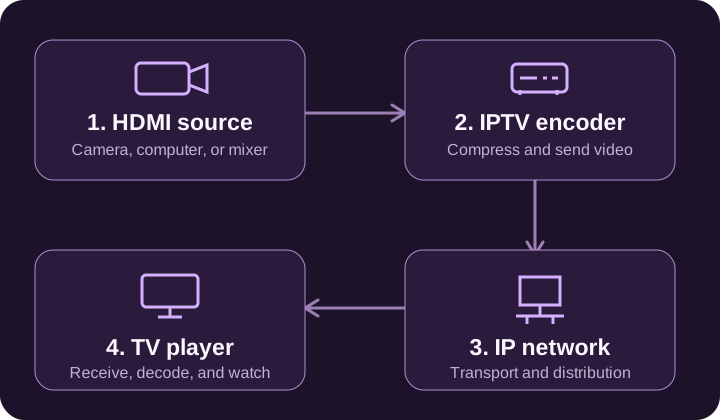
How does an IPTV encoder work?
A camera, computer, or video mixer produces a picture and sound. An encoder compresses that source into a format a receiving system can use, then sends the result over a network. A server may distribute the stream to viewers, and a player decodes it for the screen. Encoding reduces the amount of data that needs to be transported.
The full path matters: source, encoder, network, distribution service, and player. A problem at any stage can affect the picture. A fast encoder alone cannot fix a weak connection or a player that does not support the chosen format.
HDMI to IPTV: what changes?
An HDMI IPTV encoder accepts an HDMI source and creates a network stream. HDMI carries the local audio and video signal into the encoder; Ethernet usually connects the encoder to the network. A simple HDMI cable or adapter does not perform this compression and streaming work by itself.
Before connecting equipment, check the supported input resolution, frame rate, audio format, and output protocol in its documentation. An HDMI input specification can differ from the maximum encoded output. The receiving service must accept the stream format you send.
What to check in a 4K IPTV encoder
Check the complete input-to-output specification when comparing HD and 4K equipment. A device may accept a 4K signal but encode at a lower resolution or frame rate. Also check the codec, bitrate range, simultaneous outputs, and receiving device support.
Higher resolution does not automatically mean a better viewing experience. Source quality, available bandwidth, compression settings, and playback support all affect the result. For a real installation, test your own source and destination together before choosing settings for regular use.
H.264, H.265, and streaming protocols
A codec compresses and decompresses video. H.264 is commonly used for streaming, while H.265 is also called HEVC. Choose a format that your entire workflow supports, including the server and final player. Encoder support alone is not enough to guarantee playback.
A delivery protocol has a different role: it carries or delivers the stream. Equipment may offer RTMP, SRT, RTSP, HLS, or other outputs. The supported combination of codec and protocol varies by product and destination. Use the destination service’s current requirements when configuring an output, rather than treating these names as interchangeable.
Hardware encoders and software encoders
A hardware encoder is a dedicated device that handles video compression. A software encoder runs as part of a computer-based workflow and may use the computer’s processor or supported graphics hardware. Both approaches need compatible inputs, output formats, and enough processing capacity for the chosen settings.
Write down the job first: number of input sources, resolution, output destinations, operating hours, and who will manage the system. That makes it easier to compare equipment without choosing only by a headline specification or an advertised price.
Do you need an encoder to watch IPTV?
For a normal viewing subscription, the video has already been prepared for delivery. You generally use a supported player on a compatible Smart TV, streaming device, phone, tablet, or computer. A receiving box or app has a different job from an encoder used to send video.
IPTV Encoder is the name of this subscription and support website. This guide explains the technology; it is not a hardware product listing. If you want to watch TV, start with your device model, the channels you need, and how many screens will be used at once.
Choose your next step.
For a home viewing plan, compare IPTV subscriptions and USD prices. If you are unsure about your TV or streaming device, ask us to check compatibility. The IPTV FAQ covers common setup and screen-count questions.
For an encoding project, make a shortlist from your actual source and destination requirements. Check the manufacturer’s current documentation and test the complete workflow. This website does not sell encoding hardware or publish product prices for it.